Guide · GPS & Tracking
GPS walkie talkies: the feature that splits the category in two
Ask a room of nationwide-radio buyers whether their handsets should report their location, and you will start an argument. One half runs fleets and cannot work without it. The other half considers it the reason to buy a different brand. Both are right — here is how to tell which half you are in.
How GPS works in a PoC radio
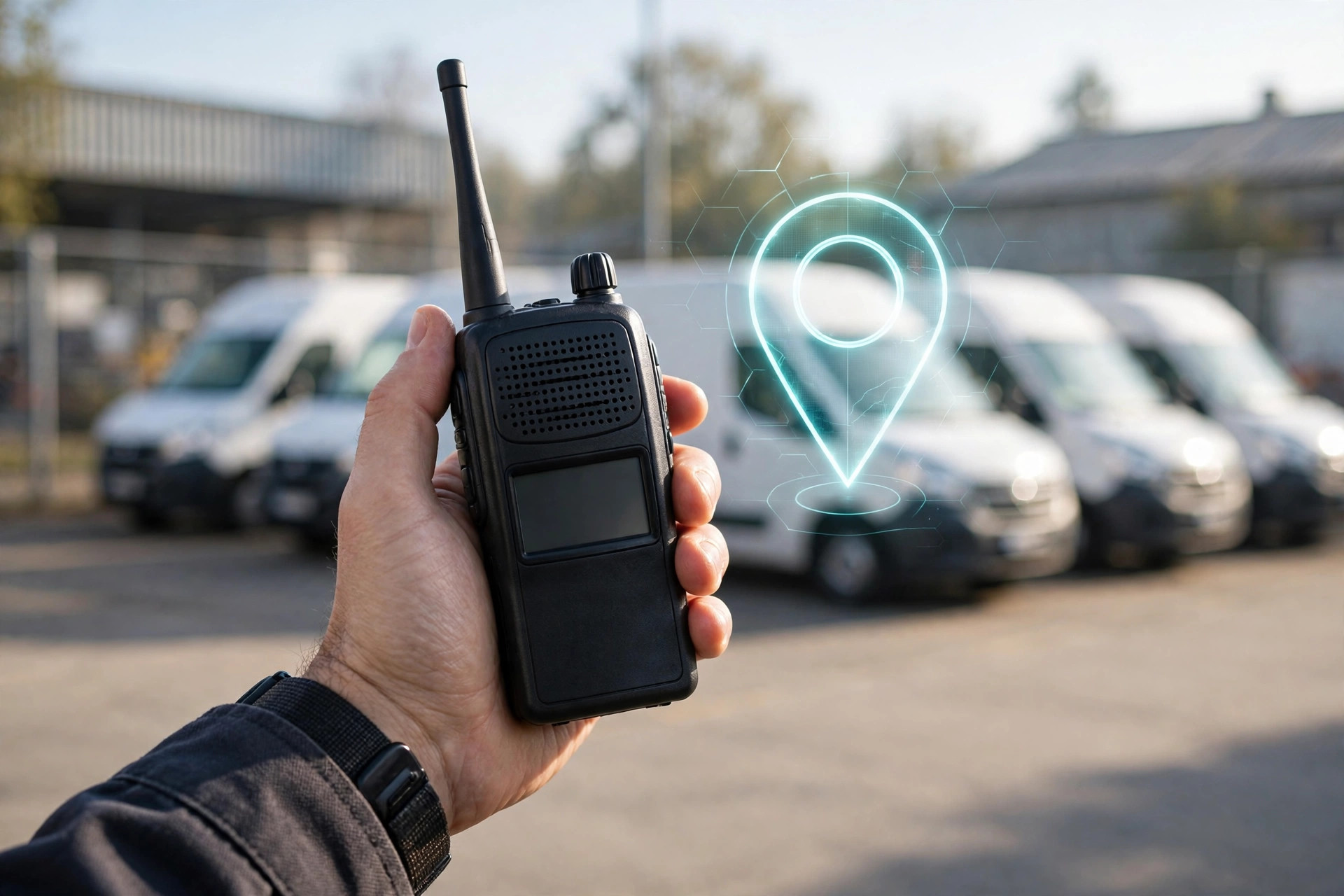
A GPS walkie talkie carries a satellite positioning receiver alongside its cellular modem. The receiver works out where the handset is; the cellular connection reports that position back to the service, where it appears on a map or in an app for whoever manages the fleet. Because a PoC radio is already a connected data device, adding GPS turns it into a live tracking unit with voice attached — every radio check-in can carry a location, and dispatch can see the team’s positions in something close to real time. It is worth separating two ideas the listings blur together: the GPS receiver itself works anywhere it can see the sky, but reporting that position needs the cellular connection, so a GPS PoC radio in a dead zone knows where it is and cannot tell anyone.
Who actually needs GPS tracking
Fleets and delivery operations are the clearest case. A dispatcher assigning the nearest driver, verifying a route, or answering a customer’s “where is my delivery?” needs positions, not voice check-ins. For them, GPS is not a feature; it is the product, and the radio is a tracker that also talks.
Event and venue teams are the second case. A festival, stadium, or campus runs on knowing where security, medical, and operations staff actually are when something happens. A map of the team shortens every response.
Family safety is the third case, and the most personal. Parents equipping teenagers for a road trip, or families coordinating across a large site, may value a location pin over privacy — a judgement call that belongs to the family, and one the listings’ “For Fleet/Security Team/Family” language is aimed squarely at.
And then there is everyone else: teams who coordinate by voice, know where their people are because they assigned them there, and gain nothing from a location log except the log itself. For them, GPS is not a feature at all — it is a liability with a battery cost.
The two camps: GPS class vs the privacy camp
The market has organised itself around this divide, and the brands are not shy about it. On the GPS side sit the Amazon-class PoC brands. KaYoTom’s G09 leads with real-time GPS tracking in a four-pack pitched at fleets, security teams, and families, with a SIM included and a “lifetime free” claim attached. Airiton’s AI-K28 sells the same combination — GPS, LTE PoC, SIM included, lifetime-free positioning — often at a lower listed price. XOTODREM also sells into this class, with the caveat that its “lifetime” service requires a free renewal by IMEI each year. These are the radios our buyer’s guide ranks as the GPS picks — the links to them on this site are affiliate links, labelled as such wherever they appear.
Check KaYoTom G09 price on Amazon Check Airiton AI-K28 price on Amazon
Affiliate links — we may earn a commission at no extra cost to you.
On the other side stands Echo Radios, which has made the absence of GPS its signature. Its RIGR page stresses no location tracking, no data backup or storage, no SIM registered to your name, and no logs. Read that list again: it is a privacy policy written as a product page, aimed at buyers who have noticed that a connected radio can be a tracking device and would rather it wasn’t. Neither camp is bluffing. They are selling genuinely different products to genuinely different buyers, and the worst outcome in this category is buying from the wrong camp — a fleet that cannot see its trucks, or a family that discovers its radios keep a location history it never wanted.
The worst outcome in this category is buying from the wrong camp: a fleet that cannot see its trucks, or a family that discovers its radios keep a location history it never wanted.
What to check before buying a GPS walkie talkie
- How the location is viewed. Is there a dispatcher app or web map? Who can see it, and can access be limited per person? A tracking feature without access control is a privacy incident waiting for a date.
- How often it reports. “Real-time” in listings can mean anything from continuous tracking to a position sent when the radio is used. Check the listing’s specifics, and recent buyer reviews, for how the reporting actually behaves.
- What the lifetime claim covers. GPS reporting rides on the SIM service. KaYoTom and Airiton claim $0 lifetime SIM service; XOTODREM requires a yearly IMEI renewal to keep its lifetime status; TIDRADIO is not lifetime at all. If the service lapses, the tracking does too.
- Consent and policy, if it’s for work. Tracking employees carries legal and morale dimensions that vary by place and situation. If you are equipping a team, tell them the radios report location, and check your local rules — this page is buying guidance, not legal advice.
- Battery expectations. A receiver that fixes position and a modem that reports it both draw power. Expect GPS-heavy use to shorten battery life versus voice-only use, whatever the headline battery claim says.
- The dead-zone caveat. GPS position reporting needs cellular coverage to reach the map. Off-grid, a GPS PoC radio is a voice radio that cannot talk and a tracker that cannot report — conventional radios or satellite devices are the right tools there.
GPS beyond PoC: why your search results may confuse you
If you have searched for a “GPS walkie talkie,” you have probably noticed something odd: the results are full of amateur (ham) and digital mobile radio handsets, not nationwide PoC radios at all. That is because GPS has been a feature of the hobbyist and professional radio world for years — APRS-equipped ham radios and DMR sets can beacon their position to other radios — and that world has a decade’s head start in search results. The products are genuinely different. A ham or DMR radio with GPS shares its position with other radios in direct range, on bands that require a licence, for an audience of fellow enthusiasts. A PoC radio with GPS reports its position over the cellular network to a dispatcher’s map, anywhere in the country, with no licence at all. Some GMRS models also offer GPS features, within GMRS’s local range. None of these is the “right” answer in the abstract — but if what you pictured was a dispatcher watching a fleet on a map, the PoC class is the one you mean, and the ham results are a detour. Check which system a listing belongs to before comparing prices across the divide: a cheap GPS ham handset is not a cheap fleet tracker, however similar the product photos look.
One more distinction the listings blur: a radio can receive GPS — knowing its own position — without reporting it anywhere useful to you. What fleet and family buyers actually want is the reporting: positions transmitted to a map or app that someone else can open. When a listing says “GPS,” confirm it describes live location reporting to a dispatcher view, not merely a receiver that shows coordinates on the handset’s own screen.
And if you have decided you don’t want GPS?
Then the decision is already made, and it points the other way: Echo Radios is the nationwide walkie talkie built around not tracking you, with nationwide push-to-talk over LTE, a $20-per-device annual fee after the first year, and no location features to switch off because there are none to begin with. Our Echo Radios review covers it in full.
See Echo Radios — the no-GPS option
Affiliate link — we may earn a commission at no extra cost to you.
The bottom line
GPS in a walkie talkie is not good or bad — it is a fork. Fleets, event operations, and safety-minded families should buy the GPS class and verify the service terms. Everyone else should notice that the loudest privacy promise in the category comes from the brand that left GPS out entirely, and decide which promise they were actually shopping for.