Review · Updated November 2026
Echo Radios review: the nationwide radio, with the fine print read aloud
Echo Radios makes the boldest promise in two-way radio — press a button, talk across the country, never pay a monthly fee. The promise is mostly real. This review covers what the product is, what it costs over time, and the one design decision that will make it perfect for some buyers and wrong for others.
Disclosure, before anything else
This page contains our affiliate link for Echo Radios — if you buy through it, we may earn a commission at no extra cost to you. That relationship is exactly why this review leads with the product’s fee and its missing GPS rather than burying them: the link is disclosed, and the criticism is on the record. Full disclosure.
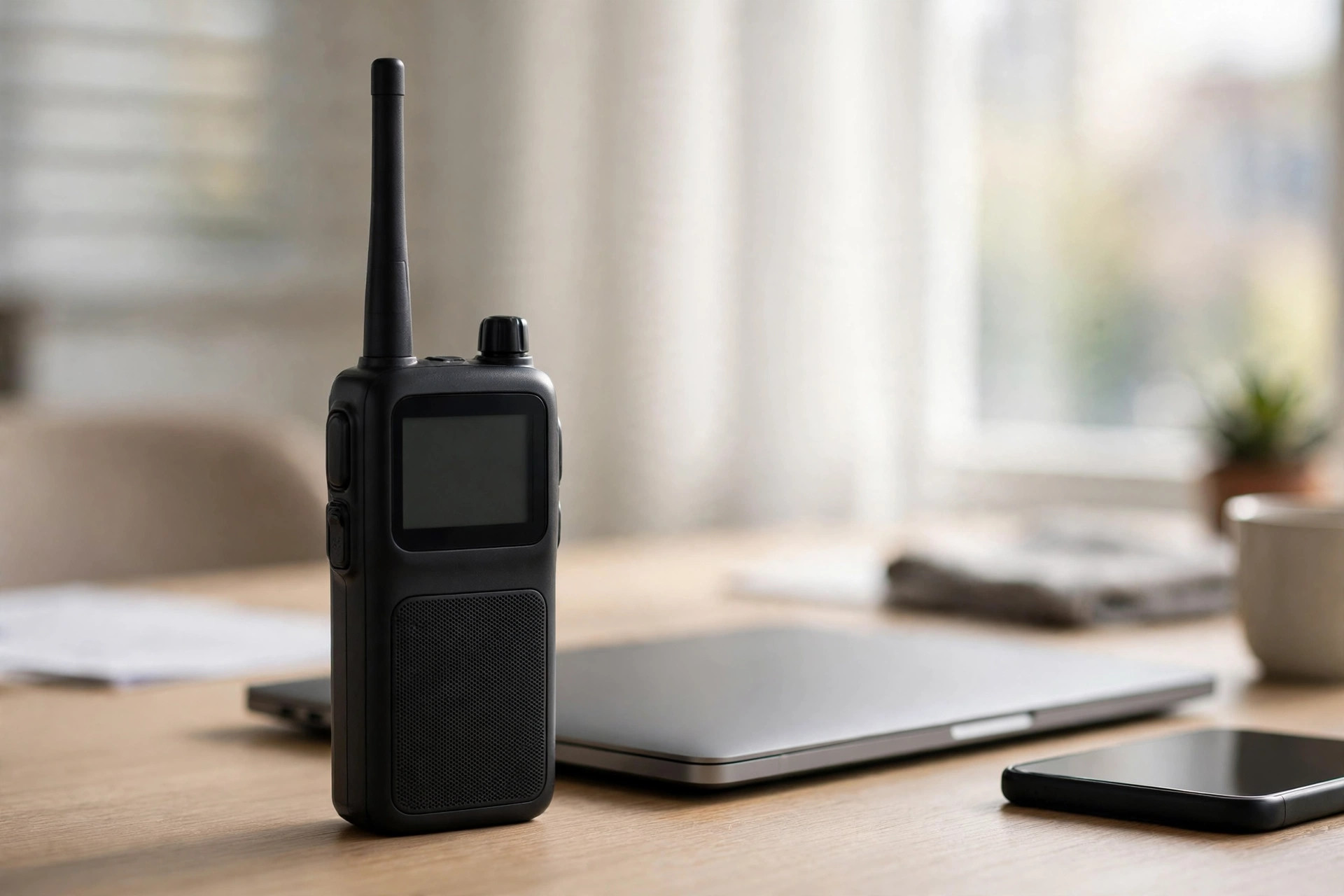
What Echo Radios actually is
Echo Radios sells push-to-talk over cellular — PoC — handsets. They look and feel like traditional two-way radios: hold the button, speak, release. The difference is invisible but total: instead of broadcasting on a radio frequency to whoever is in range, your voice is sent as data over the LTE mobile network to the specific radios on your channel, wherever they happen to be. Two handsets in the same building work. Two handsets in different states work the same way. The “range” is the footprint of the cellular network — Echo advertises “over 3,000 miles,” which is a fair description of coast-to-coast coverage, provided both ends have signal.
Echo emphasises a few engineering points in its marketing: the radios connect to multiple cellular networks rather than depending on a single carrier, which should reduce dead spots; calls are encrypted with AES-256; the battery is claimed to last five days; and the system works without any FCC licence, because the radio frequencies involved belong to the carriers, not to you. It also says the radios work worldwide — true in the sense that PoC works wherever compatible data coverage and the service’s arrangements reach, but buyers planning international use should confirm the details with the company rather than assume them. If you want the technology explained from first principles, our guide to how nationwide walkie talkies work goes deeper.
The models and the pricing
Three models anchor the range as of November 2026. The standard Echo Radios PTT Walkie-Talkie is listed at $199.99, sold in packs of two, three, four, and six, with base and car units in the line. The Echo Radios Pro is $229. And the RIGR is $159.99 — a dual-mode radio that combines PoC with a conventional UHF mode, which the company says covers up to about 10 miles over open terrain when there is no cellular signal. That fallback makes the RIGR the most interesting model in the range for anyone who works at the edge of coverage: every pure PoC radio, from every brand, is a paperweight in a dead zone, and the RIGR is the exception in this line.
Pricing caveat, stated plainly: Echo, like its main rival, runs promotions aggressively, and the struck-through “was” prices on its pages ($649.99 for the standard model, for example) should be read as marketing rather than as a price anyone necessarily paid. Judge the product on the price at checkout today, not on the discount claimed next to it. During our research the range also showed sold-out notices on some models — stock moves, so check the product page.
See current Echo Radios models and pricing
Affiliate link — we may earn a commission at no extra cost to you.
The fee: $20 a year, from year two
Fee Truth “No monthly fees” — and one annual one
Echo’s headline is “NO MONTHLY FEES – NO CONTRACTS,” and it is accurate: there is no monthly charge and no contract. But the company’s own FAQ adds the part the headline leaves out — the first year of service is included, and from year two the service costs $20 per device, per year. Echo positions that against rivals charging $20–$50 per month, and on that comparison it wins easily. It is also genuinely cheaper than its closest rival: Rapid Radios charges about $50 per radio per year after its first year ($40 on autopay).
The fee still matters at scale. Ten radios cost $200 a year to keep running; fifty cost $1,000. A family buying a pair will barely notice $40 a year. A facilities manager should put the line in the budget now rather than discover it in month thirteen. We count this as honest-but-quiet pricing: the information is published, in the FAQ, for anyone who reads it. Most buyers won’t — which is why it is in this review, in a box.
The no-GPS stance: a feature, if you want it to be
The most unusual thing about Echo Radios is what it refuses to do. The GPS-equipped end of this market — KaYoTom’s G09, the Airiton AI-K28 — sells live location tracking as the headline feature. Echo sells the opposite. Its RIGR page stresses “no location tracking, no data backup or storage,” no SIM registered to your name, and no logs. In a category where a radio can double as a tracker, Echo has decided that privacy is the differentiator.
Whether that is a pro or a con depends entirely on who is holding the radio. A family that wants to talk across the country without generating a location history will read it as the best feature in this review. A parent who wants to see where a teenager’s radio is will read it as a missing feature. A dispatcher running a fleet — the single most common business use for GPS radios — cannot use Echo for location at all, full stop, and should be shopping the GPS class in our GPS walkie talkies guide instead. We score it as a deliberate, defensible product decision — and the single most important fork in this entire category. Decide which side of it you are on before you spend anything.
Who Echo Radios is for — and who it isn’t
It fits: distributed teams, event crews, warehouses with satellite sites, churches and schools spread across campuses, families spread across states, road-trip convoys, and anyone who has ever shouted into a phone on speaker while driving. It fits buyers who want push-to-talk’s one-button simplicity without a monthly bill and without being tracked.
It does not fit: fleets that need live GPS location (buy the GPS class); anyone working regularly outside cellular coverage — rural dead zones, deep valleys, offshore — where a traditional radio or satellite communicator is the right tool (the RIGR’s UHF fallback is a partial exception); and buyers who need a radio that costs literally nothing after purchase, where a $0-lifetime-SIM Amazon-class radio is the honest recommendation despite its thinner support.
Pros
- Genuine nationwide push-to-talk over LTE, with multi-network connectivity
- No monthly fee and no contract; the lowest annual renewal in its class at $20/device/yr after year 1
- RIGR adds a UHF off-grid fallback (~10 miles open terrain) — unique among the direct brands
- Privacy by design: no GPS, no location tracking, no logs
- No FCC licence required; AES-256 encryption; claimed five-day battery
Cons
- No GPS at all — fleets needing live location must look elsewhere
- The $20/device/year fee from year two is real, and scales with fleet size
- Dead without cellular coverage (except the RIGR’s UHF mode)
- Promotional pricing is aggressive; “was” prices should be ignored
- Stock can be intermittent — models showed sold out during our research
Day to day: channels, coverage, and living with it
Ownership of a PoC radio is mostly ownership of a service, and the daily experience follows from that. Channels are defined in software rather than by frequency, so a team can be reorganised — a new channel for a new site, a temporary group for an event — without touching the hardware or coordinating frequencies with anyone. There are no strangers on your channel and no interference from a neighbouring business, the two chronic annoyances of open FRS and GMRS channels, because access is controlled by the service rather than by whoever happens to be transmitting nearby. Calls are encrypted in transit — Echo specifies AES-256 — which puts these radios in a different privacy class from conventional sets that anyone with a scanner can hear.
Coverage behaviour is the other half of daily life. Because the radios can connect to multiple cellular networks, they hold on in the marginal places — the edge of town, the far warehouse — where a single-carrier device might drop. The failure mode, when it comes, is binary rather than gradual: a conventional radio gets scratchier as you walk away from your team, while a PoC radio is either connected or silent. Buyers used to analogue radios should expect that difference, and teams whose work includes known dead zones should test there first — or choose the RIGR, whose UHF mode keeps a local channel alive off-grid. Battery life follows the same network logic: the claimed five days is a standby-and-moderate-use figure, and heavy talk time in weak signal, where the radio works harder to hold its connection, will shorten it. None of this is unusual for the category — it is the category, experienced from the inside.
Verdict
Echo Radios is the nationwide walkie talkie we recommend first, and it earns that position on arithmetic rather than adjectives: the same nationwide push-to-talk as its premium rival, at a lower renewal cost, with a dual-mode model for the coverage-edge cases and a privacy stance nobody else in the category offers. Its two weaknesses are not hidden flaws so much as declared positions — there is a modest annual fee after year one, and there is no GPS, on purpose. If neither of those disqualifies it for you, it is the strongest buy in the category. If you need GPS, our buyer’s guide ranks the alternatives with the same fee maths applied.
Affiliate link — we may earn a commission at no extra cost to you. Prices checked November 2026; confirm the current price and renewal terms before buying.
Last checked: November 2026. This review is based on manufacturer specifications, FAQs, and terms — see our editorial standards.